30/12/2025
Hai Phong Cooperates in Organizing the UNESCO Certificate Reception Ceremony recognizing the Yen Tu – Vinh Nghiem – Con Son, Kiep Bac complex
as a world cultural heritage site
On the evening of December 20, at the Yen Tu Scenic and Historic Site (Yen Tu Ward, Quang Ninh Province), the Ministry of Culture, Sports and Tourism, in coordination with Quang Ninh Province, Hai Phong City, and Bac Ninh Province, solemnly held a ceremony to receive the UNESCO certificate recognizing the Yen Tu – Vinh Nghiem – Con Son, Kiep Bac Complex as a World Cultural Heritage Site.
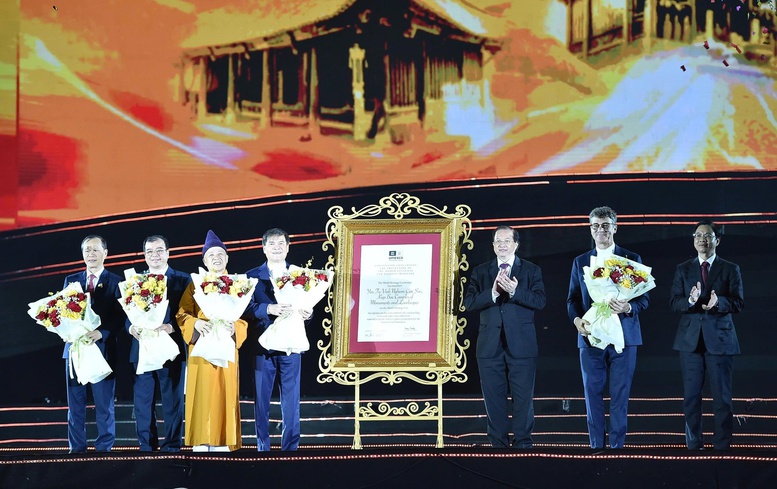
The ceremony was attended by Mai Van Chinh, Member of the Party Central Committee and Deputy Prime Minister of the Socialist Republic of Viet Nam; Mr. Jonathan Wallace Baker, Head of the UNESCO Office in Viet Nam; representatives of foreign embassies; and leaders of central ministries and agencies.
Representing Hai Phong City were Le Tien Chau, Member of the Party Central Committee, Secretary of the Hai Phong Party Committee and Head of the National Assembly Delegation of the city: Nguyen Minh Hung, Vice Chairman of the Hai Phong People’s Committee, along with current and former city leaders and representatives of departments, agencies, and localities.
With its Outstanding Universal Value, on July 12, 2025, at the 47th Session of the World Heritage Committee held in the French Republic, the Yen Tu – Vinh Nghiem – Con Son, Kiep Bac Complex was officially inscribed on the UNESCO World Heritage List.
This recognition reflects the international community’s appreciation of a distinctive cultural, historical, and spiritual landscape closely associated with the Truc Lam Zen Buddhism School of Yen Tu, founded by King-Monk Tran Nhan Tong. This uniquely Vietnamese Buddhist tradition embodies a deeply engaged spiritual philosophy, harmonizing Buddhism with national culture and promoting the ideology of the “Three Harmonies”: reconciliation, harmony, and peace—values that remain relevant today.
The inter-provincial heritage complex consists of 12 component sites with close organic connections, of which the Yen Tu Scenic and Historic Site plays a central and symbolic role, closely linked to the spiritual journey, enlightenment, and legacy of King-Monk Tran Nhan Tong and the formation of the Truc Lam Zen tradition.
To achieve inscription, the three localities of Quang Ninh, Bac Ninh, and Hai Phong undertook a rigorous and long-term scientific documentation process spanning 13 years, involving extensive research materials and hundreds of domestic and international scientific conferences and workshops. Despite numerous challenges, including periods when the nomination dossier was removed from the review list, the authorities, scientists, and experts remained steadfast in refining the dossier in accordance with UNESCO’s stringent criteria.
Speaking at the ceremony, Mr. Jonathan Wallace Baker, Head of the UNESCO Office in Viet Nam, emphasized that World Heritage inscription not only honors the past but also entails a shared responsibility to safeguard the heritage for future generations. UNESCO reaffirmed its commitment to supporting Viet Nam in conservation efforts, inter-provincial management, sustainable tourism development, climate change adaptation, and strengthening community participation.
Delivering a keynote address, Deputy Prime Minister Mai Van Chinh affirmed that the Yen Tu – Vinh Nghiem – Con Son, Kiep Bac Complex represents an integrated heritage space, harmoniously combining tangible and intangible heritage, nature and architecture, history and spiritual life. From this heritage landscape, profound values of peace, tolerance, compassion, and harmony with nature have emerged and endured for centuries.
Eleven years after the recognition of the Trang An Landscape Complex in 2014, this inscription marks Viet Nam’s ninth World Heritage Site, further affirming the country’s position and responsibility in safeguarding the cultural heritage of humanity.
The Deputy Prime Minister highlighted that the success of the nomination dossier is the result of close and effective coordination among central ministries and the three localities, serving as a model for efficient inter-provincial heritage management in line with international standards.
The Government of Viet Nam reaffirmed its commitment to strictly protecting the integrity, authenticity, and Outstanding Universal Value of the heritage; implementing comprehensive, inter-sectoral, and inter-regional management; linking heritage conservation with sustainable cultural tourism development and improved livelihoods for local communities; and promoting the central role of communities in preserving and disseminating the spiritual values of Truc Lam Buddhism.
Within the framework of the ceremony, a special artistic program entitled “Sacred Heritage Lands – Radiant Glory” was staged, featuring three elaborate chapters: Echoes of the Heritage Land, Radiant Glory, and Harmony Rising – Viet Nam’s Aspiration, with the participation of renowned artists.
